By Festus Damilare Ukolo | Fact Frontier.
Click here to read more about the reporter.
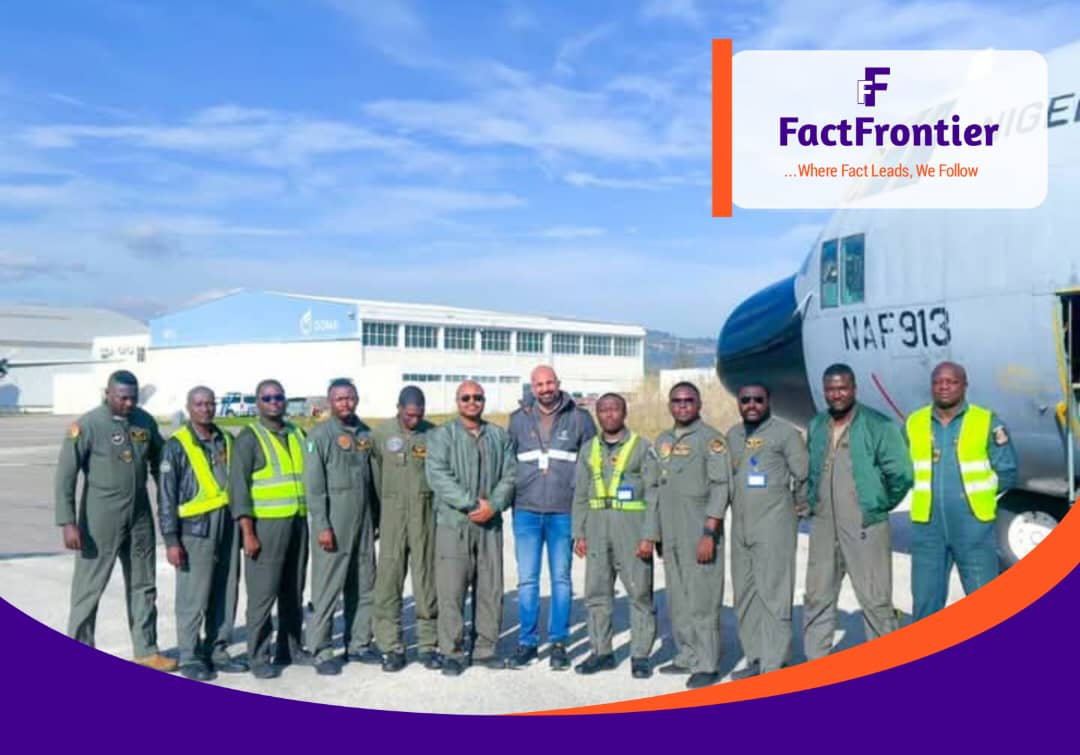
In a quiet conclusion to an international incident that strained regional relations, a Nigerian Air Force (NAF) C-130H Hercules military transport aircraft touched down at the OGMA maintenance facility in Lisbon on December 26, 2025. Its arrival marked the final chapter of a nearly three-week saga that began with an unexpected detention in Burkina Faso and required high-level diplomacy to resolve.
The aircraft, with registration NAF 913, was formally handed over to OGMA—Aviação e Tecnologia, S.A. for a scheduled "Depot Level Maintenance." A statement released by the Nigerian Air Force Director of Public Relations and Information, Air Vice Marshal Edward Gabkwet, confirmed the safe arrival, stating the ferry flight transited through Banjul, The Gambia, and Casablanca, Morocco.
The handing over of the aircraft to OGMA signals the commencement of its intended Depot Level Maintenance,Gabkwet noted, adding that the NAF looked forward to its return "in optimum operational condition."
Background: A Controversial Detention in Bobo-Dioulasso
The aircraft's path to Portugal was far from routine. On December 8, 2025, the C-130 made an unplanned landing at the Bobo-Dioulasso airport in Burkina Faso. What happened next triggered a diplomatic crisis. Burkinabè authorities detained the aircraft and its crew of 11 Nigerian military personnel.

The official narratives from the two nations immediately diverged. The Nigerian government maintained the landing was an unscheduled but necessary safety diversion. In its statement, the NAF attributed the stop to a "technical problem," asserting the crew acted "in line with standard operational procedures" to land at the nearest suitable airfield.
However, authorities in Burkina Faso, backed by the Alliance of Sahel States (AES)—a regional bloc comprising Burkina Faso, Mali, and Niger—presented a starkly different version of events. They framed the incident as a deliberate violation of their airspace. In a joint statement, the AES governments declared the aircraft had entered Burkinabè airspace "without authorization," labeling it an "unfriendly act" and a breach of sovereignty. They explicitly rejected Nigeria's technical fault explanation, creating a firm deadlock.
The Diplomatic Resolution
The detention of a sovereign nation's military aircraft and personnel is a severe incident. To secure their release, Nigeria dispatched a high-level delegation led by the Minister of Foreign Affairs, Yusuf Tuggar, and including the Chief of Air Staff, Air Marshal Hasan Abubakar. After several days of negotiations, the crew and aircraft were released in mid-December, following what the NAF described as "a series of diplomatic engagements."
The resolution, while successful, left the core dispute publicly unresolved. Nigeria stood by its technical difficulty claim, while the AES nations upheld their sovereignty violation accusation. This public disagreement highlighted the frayed political and security relations between Nigeria and the military-led governments of the Sahel, which have pivoted away from traditional Western and regional allies like ECOWAS.
The Aircraft's Mission and Maintenance
Despite the geopolitical friction, the aircraft's ultimate mission was logistical. The C-130H, a workhorse for air forces worldwide, was en route to OGMA, a renowned Portuguese aerospace company, for extensive maintenance. Such depot-level maintenance is a comprehensive process involving deep inspection, repair, overhaul, and testing of airframes, engines, and systems to restore the aircraft to its full service life.
OGMA has a long-established history as a maintenance, repair, and overhaul (MRO) center for C-130 fleets from numerous countries. The NAF's choice of this facility aligns with a history of international military technical cooperation, separate from the recent political tensions.
Implications and Analysis
The incident's closure with the aircraft's arrival in Portugal provides a face-saving off-ramp for all parties but leaves underlying tensions simmering. For Nigeria, it was a costly reminder of the volatile political landscape in its immediate neighborhood, where airspace violations are treated with utmost seriousness by juntas sensitive to perceived external threats.
Security analysts suggest the event will likely compel the NAF and other regional air forces to exercise even greater caution in flight planning and diplomatic clearance procedures when operating near the borders of AES member states. The case also underscores how technical military logistics, such as overseas aircraft maintenance, can become entangled in broader international disputes in a region experiencing significant geopolitical realignment.
While NAF 913 now sits in a hangar in Lisbon for its necessary technical overhaul, the incident it precipitated continues to resonate as a footnote in the complex and evolving story of West African security and diplomacy.